CLEANING ADVICE
Caring for Natural Stone: What Every Homeowner Should Know
Natural stone has a quality that manufactured surfaces often try to replicate. Its subtle variations, distinctive veining and natural textures bring warmth and individuality to kitchens, bathrooms, flooring and outdoor spaces.
From marble benchtops and limestone tiles to travertine bathrooms and granite surfaces, natural stone is a popular choice in both contemporary and traditional Australian homes.
However, natural stone requires a different approach to cleaning and maintenance than many other household materials.
A product that works perfectly well on ceramic tiles or laminate can permanently damage certain types of stone. Even everyday substances such as lemon juice, vinegar and some bathroom cleaners can leave visible marks.
Understanding the material, choosing appropriate cleaning methods and recognising the difference between staining and surface damage can help preserve natural stone for years to come.
Understanding the different types of natural stone
Not all natural stone behaves in the same way.
The composition, porosity and finish of a stone influence how it responds to moisture, cleaning products and everyday wear.
Marble
Marble is valued for its distinctive veining and elegant appearance. It is commonly used for benchtops, bathroom vanities, splashbacks and flooring.
However, marble is sensitive to acids.
Substances such as vinegar, lemon juice and some household cleaning products can react with the stone, leaving dull marks known as etching.
Polished marble can also show scratches and wear more readily than some harder materials.
Travertine
Travertine is a form of limestone often recognised by its warm, earthy tones and natural texture.
It is frequently used in bathrooms, flooring, outdoor entertaining areas and pool surrounds.
Travertine can contain natural pores and cavities, which may be filled during manufacturing.
Like marble, it is sensitive to acidic products and requires cleaning methods suited to its finish.
Limestone
Limestone is often selected for its soft, understated appearance.
It can be found in flooring, bathrooms, feature walls and exterior paving.
Many limestones are relatively porous and susceptible to staining if liquids are allowed to penetrate the surface.
Limestone is also vulnerable to acid etching, making product selection particularly important.
Granite
Granite is generally harder and more resistant to scratching than marble or limestone.
It is frequently used for kitchen benchtops and other surfaces exposed to everyday use.
However, granite is not completely maintenance-free.
Its porosity varies, and some varieties may benefit from sealing. Certain cleaners and prolonged exposure to substances can also affect the surface or its protective treatment.
Other natural stones
Slate, sandstone, quartzite and other natural stones have their own characteristics.
Even within the same stone category, properties can vary significantly.
For this reason, identifying the exact material and finish is the best starting point for establishing a suitable cleaning routine.
How to clean natural stone safely
For many natural stone surfaces, regular cleaning can be relatively straightforward.
The most important consideration is using products and methods compatible with the stone.
A gentle approach is generally preferable to aggressive scrubbing or strong chemicals.
For routine cleaning:
- Remove loose dust and grit using a soft cloth, suitable dust mop or non-abrasive cleaning tool.
- Use a cleaner specifically recommended for the particular natural stone and its finish.
- Follow the manufacturer's dilution and application instructions.
- Wipe or mop using a soft, non-abrasive material.
- Remove any remaining cleaning solution as directed.
- Dry the surface where appropriate to minimise water marks and residue.
For some stone surfaces, a small amount of mild detergent in water may be suitable, but this should not be assumed for every finish or protective treatment.
When uncertain, consult the stone supplier or installer before introducing a new cleaning product.
Avoid leaving surfaces excessively wet, particularly where the stone, grout or underlying installation may be sensitive to moisture.
Can you use vinegar to clean marble or travertine?
No. Vinegar should not be used to clean marble, travertine or limestone.
These stones contain calcium carbonate, which reacts with acids.
When vinegar comes into contact with the surface, it can dissolve a microscopic amount of the stone and leave a dull or roughened area.
This is known as etching.
The damage may appear as a cloudy patch, a loss of shine or a mark that becomes more noticeable under certain lighting.
Lemon juice, acidic bathroom cleaners and some descaling products can produce similar effects.
Importantly, etching is not simply dirt sitting on the surface. Ordinary cleaning will not reverse it.
Depending on the extent of the damage and the stone finish, professional honing or polishing may be required.
The difference between staining and etching
One of the most common sources of confusion in natural stone care is the difference between a stain and an etch mark.
Although they may look similar, they are caused by different processes.
What is a stone stain?
A stain occurs when a substance penetrates the stone and causes discolouration.
Common examples include oil, food, coffee, cosmetics and certain coloured liquids.
Stains may appear darker than the surrounding stone or create a visible change in colour.
Some stains can be treated successfully, although the appropriate method depends on the stone and the substance involved.
What is etching?
Etching occurs when an acidic substance reacts with a susceptible stone surface.
Rather than changing the colour beneath the surface, it alters the finish itself.
On polished marble, etching commonly appears as a dull mark where the original shine has been lost.
What about scratches?
Scratches are physical damage caused by abrasive contact.
Grit beneath furniture, unsuitable cleaning pads or dragging objects across a surface can leave visible marks.
Staining, etching and scratching require different treatment methods.
Attempting to remove an etch mark using a stain remover, for example, is unlikely to resolve the problem and may cause further damage.
How to remove stains from natural stone
The safest approach depends on identifying both the stone and the cause of the stain.
Fresh spills should generally be attended to promptly using a soft, absorbent cloth.
Blotting is preferable to spreading the liquid across a larger area.
For existing stains, avoid experimenting with household remedies simply because they are described online as natural or gentle.
Products such as vinegar, lemon juice, bleach and abrasive cleaning powders may damage certain stones or their sealers.
Some stone stains can be treated using a specially formulated poultice, which is designed to draw particular substances from the material.
However, poultice ingredients and application methods vary depending on the stone and stain.
Incorrect treatment can worsen discolouration or damage the surface.
For valuable stone, persistent stains or an unidentified material, professional assessment is often the safest option.
Does natural stone need to be sealed?
Many natural stone surfaces benefit from sealing, but not every stone requires the same treatment.
Sealing is commonly used to reduce the rate at which liquids penetrate porous stone.
This can provide additional time to remove spills before they cause staining.
However, a sealer does not make stone completely stain-proof.
It also does not necessarily prevent scratching, etching or damage from unsuitable cleaning products.
Whether sealing is appropriate depends on factors such as:
- The type and porosity of the stone
- Whether the surface is polished, honed or textured
- The location and intended use
- The existing protective treatment
- The stone manufacturer's recommendations
Some dense stones may require little or no additional sealing, while more absorbent materials may need periodic treatment.
A newly installed surface may already have been sealed by the supplier or installer.
Before applying another product, confirm what treatment is present and whether it is compatible with the proposed sealer.
How often should natural stone be resealed?
There is no universal resealing schedule that applies to every natural stone surface.
The frequency depends on the material, the type of sealer, exposure to moisture and everyday use.
A heavily used kitchen benchtop may have different requirements from a decorative wall or lightly used floor.
Some products provide protection for several years, while others require more frequent attention.
Rather than relying on a fixed annual schedule, follow the manufacturer's guidance and assess the condition of the existing treatment.
Darkening when water contacts the surface may indicate absorption, but a simple water test does not establish every aspect of sealer performance or determine whether resealing is appropriate.
Where the original treatment is unknown, seek advice before applying another product.
Caring for marble and natural stone benchtops
Kitchen benchtops are exposed to frequent use, making preventative habits particularly valuable.
Marble and other acid-sensitive stones require care around foods and drinks containing citrus, vinegar or other acidic ingredients.
Wiping spills promptly can help reduce the risk of staining and etching.
Chopping boards and suitable protective mats can also help prevent unnecessary contact with sharp objects, hot cookware and abrasive materials.
Avoid placing heavy or sharp objects directly onto vulnerable edges.
It is also worth paying attention to the area around sinks, where moisture, cleaning products and soap residue can accumulate.
Routine care should be based on the specific stone rather than assuming all kitchen benchtops have the same level of durability.
Cleaning natural stone bathrooms and showers
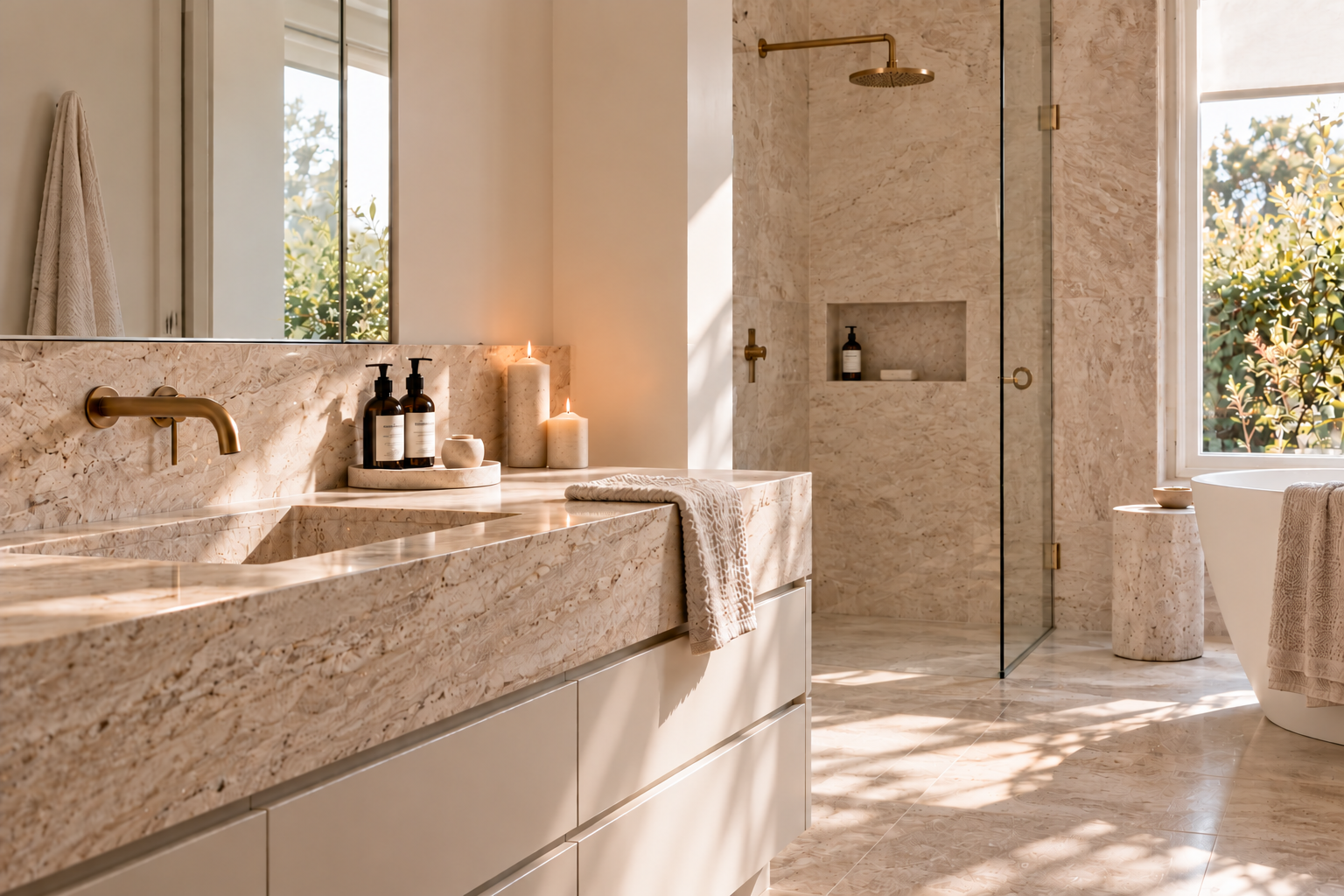
Natural stone bathrooms require particular consideration because surfaces are regularly exposed to water, soap and personal-care products.
Marble, limestone and travertine can be damaged by acidic bathroom cleaners and descalers commonly used on other surfaces.
Soap residue and mineral deposits may also become more difficult to remove if allowed to accumulate.
Using a suitable stone-safe cleaner regularly can help reduce build-up.
Where recommended for the finish, gently removing excess water from shower walls after use may help minimise water spotting.
Ventilation is also important for managing bathroom humidity.
Pay attention to grout, silicone and the condition of adjoining surfaces, as water-related problems are not always caused by the stone itself.
Avoid using abrasive brushes or strong chemicals to remove stubborn residue.
For significant mineral deposits or existing surface damage, a stone-care specialist can recommend a suitable approach.
Looking after natural stone floors
Stone flooring can be durable and attractive, but everyday grit can gradually affect its finish.
Dust, sand and small particles carried in on footwear may act as abrasives when walked across.
Regularly removing loose debris helps reduce this wear.
Suitable entrance mats can also limit the amount of grit brought indoors.
When mopping, use equipment and cleaning products appropriate for the stone and its finish.
Avoid excessive water and ensure cleaning solutions are removed as directed.
Furniture should be fitted with appropriate protective pads where necessary.
For textured or unpolished stone, cleaning requirements may differ from those of highly polished surfaces.
The objective is to maintain the stone without gradually wearing away or altering its original finish.
Natural stone outdoors: paving and pool surrounds
Travertine, limestone, sandstone and other natural stones are often used for outdoor paving, pathways and pool surrounds.
These areas face additional challenges from weather, garden debris, moisture and environmental staining.
Leaves and organic material left on stone can contribute to discolouration, particularly on porous surfaces.
Regularly removing loose debris and addressing spills can help maintain the appearance of outdoor stone.
Pressure cleaning requires caution.
Excessive pressure, unsuitable nozzles or incorrect techniques can damage softer stones, loosen jointing material or affect surface treatments.
Pool surrounds also require consideration of the stone's slip resistance, finish and exposure to pool chemicals.
Cleaning products should be selected specifically for the material and installation.
Where extensive staining, biological growth or deterioration is present, specialist advice may be appropriate.
Common natural stone cleaning mistakes
Many problems arise not from neglect, but from using products or techniques that are unsuitable for the material.
Common mistakes include:
- Cleaning marble, limestone or travertine with vinegar or acidic products
- Using abrasive scourers on polished stone
- Assuming every natural stone is waterproof or stain-proof
- Applying a sealer without identifying the existing treatment
- Leaving spills unattended on absorbent surfaces
- Using excessive water on vulnerable installations
- Attempting to polish or remove scratches with unsuitable household products
- Using high-pressure cleaning methods without considering the stone's durability
Understanding these risks can help prevent damage that may be expensive or difficult to repair.
When does natural stone need professional restoration?
Regular maintenance can preserve the appearance of stone, but some forms of damage cannot be corrected through routine cleaning.
Professional restoration may be appropriate where surfaces have:
- Extensive etching or loss of polish
- Deep scratches or uneven wear
- Persistent staining
- Damaged or deteriorating grout
- Significant surface discolouration
- Existing coatings that are peeling or failing
Depending on the stone and the problem, restoration may involve specialist cleaning, honing, polishing or other treatment.
The correct approach should be determined after identifying the material, its finish and the extent of the damage.
Not every mark requires restoration, and unnecessary treatments can sometimes alter the stone's appearance.
Frequently asked questions about natural stone care
What is the best cleaner for natural stone?
A cleaner specifically recommended for the particular stone and finish is generally the safest choice. Many routine stone-cleaning products are pH-neutral, but pH alone does not guarantee compatibility. Always check the manufacturer's guidance.
Can I use dishwashing liquid on marble?
Some mild detergents may be suitable when properly diluted, but formulations vary and can leave residue. A cleaner approved for marble is preferable, particularly for valuable or delicate finishes.
Can baking soda damage natural stone?
Baking soda can be abrasive, and homemade pastes may affect certain polished finishes. It should not be assumed safe for every stone surface. Seek material-specific guidance before using it.
Why does my marble have dull spots?
Dull spots on polished marble are often caused by etching, which occurs when acidic substances react with the stone. They may also result from abrasion or wear. Cleaning alone generally cannot restore an etched polish.
Is travertine difficult to maintain?
Travertine can be maintained successfully with suitable products and regular attention. However, its porosity, surface finish and sensitivity to acids mean it requires different care from many ceramic or porcelain tiles.
Can natural stone be cleaned with a steam mop?
Steam cleaning is not suitable for every natural stone installation. Heat, moisture and pressure may affect certain stones, sealers, grout or underlying materials. Follow the flooring manufacturer's instructions before using steam equipment.
Does sealing marble prevent etching?
No. Many stone sealers help reduce liquid absorption and staining, but they do not prevent acidic substances from reacting with marble. Sealed marble can still etch.
How do I know if my benchtop is marble or engineered stone?
Appearance alone may not be reliable. Installation documents, supplier records or product specifications are the best starting point. If the material is unknown, seek identification before applying cleaners, sealers or restoration products.
Preserving the natural beauty of stone
Part of the appeal of natural stone is that no two surfaces are exactly alike.
Variations in colour, veining and texture are part of the material's character, and some changes may develop naturally with age and use.
Maintaining stone does not necessarily mean keeping every surface looking newly installed.
It means understanding the material, protecting it from avoidable damage and choosing appropriate care methods.
With informed maintenance and attention to the details that matter, natural stone can remain a beautiful and enduring feature of the home.